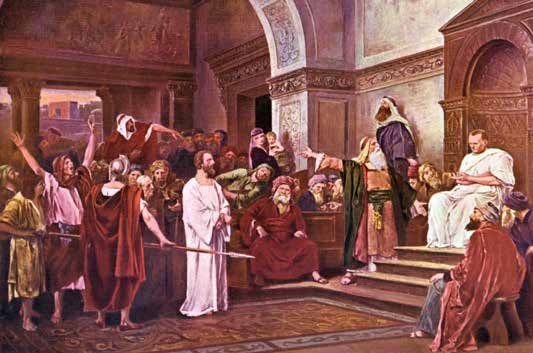
Religious drama—what is it?
A serious story by actors performing or impersonating any given dialogue in a theatrical manner, or an event of real life with emotional effects which are characteristics of a play, patterned after a religious theme. (American Heritage College Dictionary)
Is this something the church needs to be concerned about? It should be. It usually seems to get its beginning in extended “prayer and praise” services between Sunday school and church services. Or in special services other than on a Sunday morning. It can include such things as instrumental presentations, puppet shows, skits, plays, dances, and religious films.
Religious drama is not something new. It was introduced during the Dark Ages (A.D. 400 to 1200) as dramatic performances with religious themes known as “miracle plays.” These plays became so corrupt that the Catholic Church tried to put a stop to them, but to no avail. In 1242, the Passion play, a performance that depicts the death of Christ, started in Germany and it is still being performed around the world today.
An interesting observation, as we look back through time, is that religious drama was introduced during the darkest time of history (the Dark Ages), but the church emerged from this long era of moral decay through Spirit-filled, Bible-based, New Covenant-focused preaching of the Anabaptist Revival during the Reformation time period.
I. Why Drama Violates True Worship
a. Drama is a violation of the law of hearing.
In a spiritual world, seeing is not as important as hearing (2 Corinthians 4:18). The words hear, heareth, and heard are found over 1,000 times in the Bible. As a matter of fact, the whole Bible is God speaking to man. He wants mankind to hear! “Thus, saith the Lord” is a constant refrain throughout Scripture.
On Mount Sinai (Exodus 19:9), the people heard the message of God through His spokesman, Moses. God’s voice was frightening to them (Exodus 20:18-19) but hearing from Him was essential so that they “sin not.” In Exodus 20, God gave some detailed instructions of what the worship pattern was to be. Ye shall not make with me gods of silver, neither shall ye make unto you gods of gold –Exodus 20:23. These visual aids (idols) were a violation of God’s law of hearing. Through the eye gate comes the temptation to build idols. The altars that God did permit were to be plain and uncut (vss. 24-25). What they did see was not to distract from that which was heard from the altar! What is seen, especially immodesty, tends to be a distraction from what is heard (v. 26).
The preaching of Jesus appealed to the hearing: Who hath ears to hear, let him hear –Matthew 13:9. While He did not use visual aids like speakers do today, Jesus did use verbal aids (parables) as a tool to appeal to the hearing (Mat 13:18).
On the Mount of Transfiguration (Matthew 17), Peter wanted to reinvent the worship experience by building three shrines. He wanted something to see! But the voice in the clouds alerted the disciples to the importance of hearing (v. 5). Worship with visual aids is not endorsed by God!
Jesus said, Verily, verily, I say unto you, He that heareth my word, and believeth on him that sent me, hath everlasting life … The hour is coming, and now is, when the dead shall hear the voice of the Son of God: and they that hear shall live. John 5:24-25. Salvation comes by hearing the Word of God, but only when one believes what is heard!
Paul raises some sobering questions: How then shall they call on him in whom they have not believed? and how shall they believe in him of whom they have not heard? and how shall they hear without a preacher? –Romans 10:14. He answers his own questions: So then faith cometh by hearing, and hearing by the word of God –Romans 10:17. God’s law to experience salvation is either by hearing God’s Word or by reading God’s Word!
In the 2nd and 3rd chapters of Revelation, Jesus repeats seven times: “He that hath an ear, let him hear.” Religious drama is superficial in that it appeals to the soulish part of man, not the spiritual part. The soulish part of man (emotions) can have a great time while the spirit within man remains untouched and unmoved. Satan uses the eye gate to distract man from his real heart issues.
Hebrews 11:6 tells us, “Faith is the substance of things hoped for, the evidence of things not seen (or demonstrated).” Real faith comes to the human heart by hearing, not by demonstration. Therefore, religious drama borders on being anti-Christ because it is counterproductive to God’s law of hearing.
b. Drama is a violation of sincerity.
The Scriptures teach the importance of sincerity in all of life (1 Corinthians 5:8; 2 Corinthians 1:12, 2:17; Philippians 1:10). In maintaining our sincerity, it is important for each person to recognize that God has created us as unique individuals (Psalm 139:14-15). We are not and cannot be someone else! To try to be someone else violates our individual uniqueness. And, when one does so, he becomes insincere.
How does this connect with religious drama? Drama employs playacting. Jesus had a constant controversy with the Pharisees. They were constantly playacting, or pretending to be something that they were not. Jesus repeatedly called them hypocrites. The original Greek word means “play actor.”
The Pharisees’ sole motivation to pray in public was to be seen of men (Matthew 6:5-7). They were conscious of their audience, thus their performance. Jesus made it very clear that religious devotion was to be private, in “thy closet.” When a person who expresses his piety becomes more concerned about his performance than his message, he is no longer worshiping, but putting on a show! This can happen to preachers, quartets, choruses, etc. “Prayer walks” also usually fall into this same category of playacting.
When a person makes play-acting a regular habit, he becomes a hypocrite. He violates his own soul, because he injures his own uniqueness, which was given by God.
Jesus addressed the Pharisees as hypocrites seven times in Matthew 23. He informed them that they were walking dead men (Matthew 23:27-28). They had playacted for so long that they did not know the difference between the real and the unreal!
This deception is one reason that professional actors become such extremists about the issues of life. Professionally, they become increasingly detached from truth, sincerity, and reality. In such matters as ecology, animal rights, abortion, gay rights, and global warming, many of them have taken positions that are disconnected from the foundations of truth and are no longer sincere.
To pretend to pray or worship or to act out Bible characters in a play is not only insincere, but it borders on being sacrilegious. Imagine pretending to be Jesus in a play! To pretend to be Jesus is blasphemous because no Christian has ever come anywhere close to His perfection! Or, what about pretending to be the devil? Why, pray tell, would anyone who is sincerely following the teachings of Jesus take upon himself the embodiment of evil? A. W. Tozer concludes, “Playacting embodies a gross moral contradiction in that it calls a lie to the service of the truth.”
Religious drama, those who involve themselves in it, and for that matter those who approve of the very hypocrisy that Jesus condemned, are frauds. The Holy Spirit does not honor pretense and showmanship!
The reason multitudes followed Jesus was that His sincerity was so refreshing in comparison to the constant playacting of the Pharisees.
II. Practical Reasons Why Religious Drama is a Menace
a. Religious drama demoralizes reverence for God.
A person who pretends to be Jesus Christ or any other Bible character erodes his reverence for the Lord. When one playacts enough, his fear of God slowly dies within. After all, if a person can pretend to be equal to Christ, what is the need for reverence to a higher being? The Pharisees did not even suspect that they were walking dead men (Matthew 23:27).
b. Religious drama identifies worship with the theatrical world.
Hollywood has effectively proven that the theatrical world cannot produce godly moral values. Pairing a man and a woman as a pretend husband and wife breaks down the sanctity of marriage. The theatrical world also endorses courtship practices that violate the biblical standards of purity. The theatrical world has become the pacesetter of moral standards in today’s society, and many are following their ungodly pattern.
c. Religious drama does not satisfy the inner man.
When a person’s senses are titillated by outward show, the emotions keep seeking a new high and another feel-good worship experience. It creates a desire within to see yet another show that is more satisfying than the previous one. The emotions are having fun, but the inner man starves and slowly dies because the heart and mind have not been fed with real substance.
d. Religious drama ruins the preacher.
Drama is a friend to the lazy preacher. He no longer needs to: Study to shew thyself approved unto God… –2 Timothy 2:15. It requires no Holy Spirit unction to substitute a play for the sermon. Instead of commanding men to be “the light of the world,” he commands them to “lower the lights, please!” When the projector replaces the prophet, the primary means for man to find salvation is lost (1 Corinthians 1:21).
“As long as the preacher can fall back upon entertainment, the pressure that makes preachers will be wanting. The habit and rhythm which belongs to great preaching will be missing from their ministry.” –A. W. Tozer.
The use of religious drama will doom the preacher to mediocrity! The menace that we face today is that as religious drama multiplies, the heaven-sent revivals of the past will become extinct.
e. True worship will be viewed as inferior.
By using drama in a worship service, churches are training the youth to think that true worship is just another inferior form of amusement. When worship and drama are fused into one, worship is reduced to the lowest common denominator. The danger is that the next generation will not know what true worship is!
III. Patterns of True Worship
a. Prayer
Prayer is a vast subject, a worship pattern that too many times remains untapped. Public prayer in the congregational life is squeezed into our man-made time constraints.
In the early church, public prayers held a consistent pattern in their worship experiences. There was public prayer immediately after Christ’s ascension (Acts 1:14) and the first ordination (Acts 1:24). And they continued stedfastly … in prayers –Acts 2:42. No spirit of apathy was present! Prayer meetings were an evangelistic tool, a means of implementing the fear of God, and a great unifier for the whole church (Acts 2:41-44).
Peter and John attended a midafternoon prayer meeting (Acts 3:1). (Say, fellow saint, when was the last time that you attended a midafternoon prayer meeting?) Their prayer meeting had seismic results (Acts 4:31)! The power and presence of the Holy Spirit in our worship services brings results!
Prayer meeting attendance was not a monthly or a bimonthly option (Act 6:4)! When Peter was in prison, they had a voluntary, round-the-clock, prayer chain (Acts 12:5). They laid hands on their missionaries and prayed for them (Acts 13:3). They gathered at the river for a prayer meeting (Acts 16:13). Please note: this gathering at the river was not for the purpose of any kind of water sports; it was a prayer meeting! They gathered …prayer was wont to be made… –Acts 16:13. They understood that wherever Christians happened to meet, it was a normal activity to pray together.
b. Preaching
Preaching is a worship pattern that dates back to the time of Jonah (Jonah 3:2) and Moses (Acts 15:21). In the Old Testament, preaching was God’s pattern for communicating the will of God to man. When Jesus came on the scene, …[He] came into Galilee, preaching the gospel of the kingdom of God –Mark 1:14. He used the same worship pattern. Jesus used parables as verbal illustrations (not visual ones), which caught the attention of His hearers.
Near the end of His ministry, Jesus extended preaching as a worship pattern to future generations and all world cultures: …Go ye into all the world, and preach the gospel to every creature –Mark 16:15.
Paul’s call was to preach the gospel (1 Corinthians 1:17-21). Preaching was not to be embellished by the cleverness of man. It pleased God to use the foolishness and simplicity of preaching to minister salvation to those who dared to believe. For this reason, preaching needs to be the focal point of every worship service. Praise services, concerts, and musicals are robbers of time that instead ought to be invested in listening to Holy Spirit-inspired preaching. When religious drama is used to present truth, it bypasses God’s ordained pattern of bringing the message of salvation to man.
Blessed is he that readeth, and they that hear the words of this prophecy, and keep those things which are written therein… –Revelation 1:3. God’s method of communication is the written or spoken Word. Not a picture! Not a play! Not a pageant!
c. Singing
The New Testament leaves no hint of professional singers, choirs, or musical performances. Meaningful singing requires participation by all, and an intelligent involvement of the mind (1 Corinthians 14:15). The context clearly implies that worship or singing is not only an individual experience; it is for the edification of all present. Soloists, who tend to be self-exalting, prohibit the remainder of the audience from entering into a corporate worship experience.
Let the word of Christ dwell in you richly in all wisdom; teaching and admonishing one another in psalms and hymns and spiritual songs, singing with grace in your hearts to the Lord –Colossians 3:16. Spiritual songs move the heart, while soulish songs move the feet and the emotions. Our singing is “to the Lord.” Preaching is from God to man, but singing is from man to God, containing expressions of praise, adoration, honor, and thanksgiving. Singing is for worship, not for entertainment.
Speaking to yourselves in psalms and hymns and spiritual songs, singing and making melody in your heart to the Lord –Ephesians 5:19. Spirit-filled singing brings mutual edification, inspiration, and encouragement. Participation in singing has a way of ministering to heartfelt needs, where other methods fail. “Making melody in your heart” involves the accompaniment of the heart. External instrumentation tends to focus on a person’s abilities rather than on the heart. If our singing is not accompanied by our hearts, it becomes just another pharisaical worship show.
Old Testament worship was acceptable to God; nevertheless, it was also ritualistic with animal sacrifices, burning incense, using musical instruments, and dancing before the Lord. New Testament worship, however, is quite different. Jesus teaches us that we …must worship him in spirit and in truth –John 4:24. The spirit of worship replaces the rituals. When we move from intrinsic methods of worship to extrinsic methods, we violate the New Testament “spirit” of worship. Our worship is not to be stimulated by the extrinsic, but rather by the Holy Spirit (Ephesians 5:18).
IV. Essence of True Worship
When Jesus met the woman at the well, she expressed a concern about His change in worship format (John 4:20). She was concerned about how her fathers worshiped. In other words, “this is the way that we have always done it!” Every generation of worshipers must guard against formalistic worship.
There are two attitudes that affect true worship in a wrong way:
- Formal –becoming so accustomed to the way that we have always done it, that we end up merely going through the motions and losing focus on the One being worshiped.
- Casual –becoming so aloof to any form of worship that the One being worshiped becomes obscured by indifference.
Both formal and casual worship styles have one root problem: lack of reverence for God!
The fathers of the woman at the well had lost both the focus and the concept of worship: “Ye worship ye know not what” (John 4:22a). Jesus clearly indicated that worship is not thoughtless: “We know what we worship” (4:22b). True worship is the exercise of our mind and intellect. True worship has something to offer: “Salvation is of Jesus” (4:22c). It is life-changing!
The worship location is not as important as the attitude (John 4:23). The emphasis that Jesus gives is not on the outward ceremony, but on the state of the mind and spirit.
God is a Spirit: and they that worship him must worship him in spirit and in truth –John 4:24. Note the word must! The only acceptable worship is in spirit and in truth. Our attitude must be such that it is in harmony with the Spirit of God. True worship also involves our response to truth. If our spirits are not responding to truth, we are not worshiping! If our minds are somewhere else, or on anything else, our worship is merely cold, dead ritualism!
Conclusion
In the observation of the principles of Scripture, it is clear that religious drama is not God’s pattern to bring faith and life into the human soul!
The pattern of true worship in the New Testament is to gather to hear the Word preached; to pray together and for each other; and to sing songs, hymns, and spiritual songs.
The temptation to introduce new things to worship is very real today. The appeal of Jesus is to worship in spirit and in truth. When each of us sincerely does his part to keep worship services meaningful and spiritual, it reduces the temptation to reintroduce the formal (“the way our fathers worshiped”) or to introduce the casual (any new irreverent worship).
Works Cited
The American Heritage College Dictionary, New York: Houghton Mifflin Company, 2007.
The Bible—King James Version.
The Vance Havner Quotebook, Dennis J. Hester, Grand Rapids: Baker Book House, 1986.
The Menace of the Religious Movie, A. W. Tozer, Wisconsin Rapids: Rapids Christian Press.