
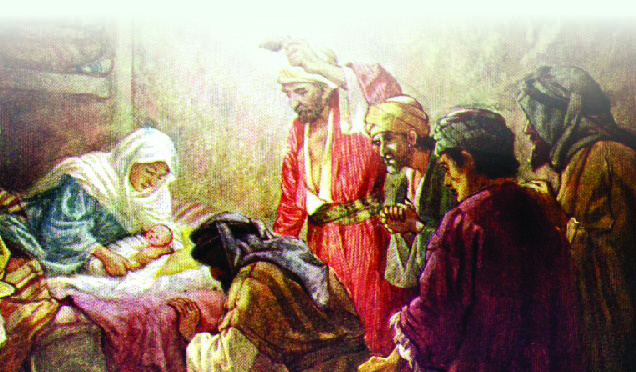
Sitting squarely on the great divide of our measured timeline of years lies the incarnate birth of our Lord Jesus Christ. He rightfully owns this place, for no other advent could so astutely impact humanity. The years before His birth are known as B.C. or “Before Christ”, while the years following are known as A.D. (Anno Domini, Latin for “The year of our Lord”). While His birth has been utterly cluttered and confused by pagan influences and personal indulgence, the simple radiant beauty of the occasion is still available for all who will but candidly gaze upon the unbeguiled scene.
While the calendar has placed the birth of Christ on December 25, most scholars have concluded that this date is inaccurate. It has also been determined that the actual year ascribed to His birth is also inaccurate by 4-6 years. The date was set by the bishop of Rome in accordance with a popular pagan festival called Saturnalia. The heathen Romans worshiped Saturn as the god of agriculture by feasting, parties, adorning their houses with evergreens, the exchanging of gifts, and general merry making. It was the bishop’s endeavor to provide a sanctifying influence upon the revelry and turn the minds of the general populace away from selfish indulgence to God incarnate. As we may well expect, the heathen festivities never missed a beat and continued on at the same pace. The church that initially frowned upon the proposition eventually accepted the idea and by the fourth century was fully acclimated and indoctrinated to the hybrid mixture of that which was Christian and pagan.
Thus, we are left with a dilemma today. How should a Christian regard the birth of Christ? Should we attempt to keep Christ in Christmas or get Him out? Regardless of our opinion, each of us must veritably resolve to understand the significance of the virgin birth apart from the emotional ties to the hybrid celebration and recognize the birth in a God-ordained fashion. In contrast to the millions who celebrate His birth in our day, there were but a paltry handful who were able and worthy to attend the actual event.
And there were in the same country shepherds abiding in the field, keeping watch over their flock by night. And, lo, the angel of the Lord came upon them, and the glory of the Lord shone round about them: and they were sore afraid. And the angel said unto them, Fear not: for, behold, I bring you good tidings of great joy, which shall be to all people. For unto you is born this day in the city of David a Saviour, which is Christ the Lord. And this shall be a sign unto you; Ye shall find the babe wrapped in swaddling clothes, lying in a manger. And suddenly there was with the angel a multitude of the heavenly host praising God, and saying, Glory to God in the highest, and on earth peace, good will toward men –Luke 2:8-14.
It was a band of lowly shepherds who received the first birth announcement. Even these foolish and unlearned men knew of, and longed for, the anticipated Messiah. But thou, Bethlehem Ephratah, though thou be little among the thousands of Judah, yet out of thee shall he come forth unto me that is to be ruler in Israel; whose goings forth have been from of old, from everlasting –Micah 5:2.
As the star-spangled heavens erupted to life, the shepherds gazed in mesmerized awe at the scene before them and a new day began to dawn upon the horizon of their souls. The angelic host proclaimed their message to the shepherds, then soon vanished; yet the good news remained. The encounter was but a brief vapor, yet a three-fold fragrance lingered in the burning hearts of these men: A Savior… A Sign… and A Song…
…A Savior
The very fact that a Savior is promised, implies that there is something that we need to be saved from. Whatever our physical lot may be, man’s spiritual condition has been on the precipice of despair since the fall in Eden. Through four millennia, the human race had cowered under the diabolical cloud of sin and many had fallen prey to its menacing darkness. Sin can take a candle of hope and snuff it out in an instant. It can breathe its icy breath upon the fairest of flowers and wilt them in an instant. It takes loving marriages and introduces them to the throes of internal war. It takes the sincere bloom of youth and robs it of the fragrance of its innocence. Those who have managed to break free from the bondage of its personal subjugation can easily see their narrow escape from the mad society about them. Thus, the humble shepherds rejoiced at the advent of a Savior.
All have sinned and come under its condemnation. The very thought of freedom from the impending jurisdiction of our just punishment is a breath of fresh air. For God sent not his Son into the world to condemn the world; but that the world through him might be saved –John 3:17. Those who have been genuinely converted carry in their soul the hope of eternal life and the promise of heaven. They become new creatures as the Holy Spirit takes up residence in their hearts. While this bears a dramatic effect on the life of a believer, these are not the only issues of salvation. This Savior is also a Lord.
Just as the title of “Savior” implies a desperate need, so likewise, the name of “Christ, the Lord” implies a dominating victory. He that committeth sin is of the devil; for the devil sinneth from the beginning. For this purpose the Son of God was manifested, that he might destroy the works of the devil –1 John 3:8. Not only shall we be freed from the condemnation of sin, we must also be rescued from its power and influence as well. The debilitating habits that we have accumulated in our sinful nature must be dealt a death blow. The passions and lusts that overpowered us before His influence came upon our lives must be subject to Him. The egotistical pride and driving temper within man that has destroyed relationships and wounded the lives of those that we love about us, must also be swallowed up in this victory. If Christ is not our Lord, then neither is He our Savior.
What child is this. Who laid to rest,
On Mary’s lap is sleeping?
Whom angels greet with anthems sweet,
While shepherds watch are keeping?
This, this is Christ the King,
Whom shepherds guard and angels sing.
Haste, haste to bring Him laud,
The Babe the Son of Mary.
…A Sign
One may well think that the angelic visitation was a much larger sign than the infant in the manger. Who among us has ever experienced the delight of hearing such a heavenly chorus? As we read the account, one can only imagine the enrapturing beauty of a myriad of celestial voices resounding together and filling the mountainside with a glimmer of heaven that earth has never known since the day of creation, When the morning stars sang together, and all the sons of God shouted for joy –Job 38:7. Yet the angels were not the sign.
The fact that this child was conceived by the Holy Ghost as detailed in Matthew 1:20, must be received by faith and can hardly be reckoned as a terrestrial sign. The fact that the child was wrapped in swaddling clothes was nothing unusual, for all mothers of the day did that. In one of the most graphic chapters depicting the birth of a child, God mentions that no one cared for Israel at their birth: And as for thy nativity, in the day thou wast born thy navel was not cut, neither wast thou washed in water to supple thee; thou wast not salted at all, nor swaddled at all –Ezekiel 16:4. These clues will be useless in a search for the child. The tell-tale sign of this event is marked by the cradle of the infant. No mother would choose a cattle lot for a birthing suite and lay her newborn in a feed trough unless necessity demanded it.
The sign of the manger in conjunction with their scriptural knowledge of Bethlehem were all that was needed for the shepherds to find the child. Scripture makes no mention of the comforts of a stable at all. The shepherds were intimately familiar with the areas of town allotted for the animals and their journey began.
Wherefore Jesus also, that he might sanctify the people with his own blood, suffered without the gate. Let us go forth therefore unto him without the camp, bearing his reproach –Hebrews 13:12-13. This sign calls for personal participation. Everyone whose heart beats loyal to the scene must also go to accompany Him. This will not be fulfilled by attending a living nativity scene, a “Messiah” performance, or by going to Grandmother’s house for Christmas dinner. We must be a partaker in his sufferings as Thomas when he said …unto his fellow disciples, Let us also go, that we may die with him –John 11:16.
To visit the Christ child will require us to haunt the place outside the inn. The Inn Crowd is the place of popular reception, popular understanding, and popular behavior. There awaits the comforts of friends, family, and fraternity, while it ministers a sense of belonging and acceptance. Christ knew no such luxury in His birth nor in His death, and He made His choice outside of the Inn Crowd.
Who hath believed our report? and to whom is the arm of the LORD revealed? For he shall grow up before him as a tender plant, and as a root out of a dry ground: he hath no form nor comeliness; and when we shall see him, there is no beauty that we should desire him. He is despised and rejected of men; a man of sorrows, and acquainted with grief: and we hid as it were our faces from him; he was despised, and we esteemed him not –Isaiah 53:1-3.
The despised shepherds lived most of their lives outside of the Inn Crowd and were the first to believe and receive Him. Loyalty to Christ requires separation from the loyalties of the world including most of its ever-popular celebration of Christ’s birth. It is a call to follow His choice to go without the camp. This is the difference between nominal worship and the heartfelt praise of His redeemed who will but follow Him to the manger.
Why lies He in such mean estate,
Where ox and ass are feeding?
Good Christians, fear, for sinners here
The silent Word is pleading.
Nails, spears shall pierce him through,
The cross he bore for me, for you.
Hail, hail the Word made flesh,
The Babe, the Son of Mary.
…A Song
Those who desire to know him must venture outside The Inn and partake in …the fellowship of his sufferings, being made conformable unto his death –Philippians 3:10. As they reap the scoffing and scorn of the Inn Crowd, they will also find that they are greeted with a heavenly song. Glory to God in the highest, and on earth peace, good will toward men –Luke 2:14.
As our portion in this earthly life diminishes, our quantum of glorious praise shall increase. The Jews were offended that the Messiah did not come to give them a larger portion and victory over the Roman world. Jesus …beheld the city, and wept over it, Saying, If thou hadst known, even thou, at least in this thy day, the things which belong unto thy peace! but now they are hid from thine eyes –Luke 19:41-42. Peace on earth will never be apprehended by environmental perfection. Those lodged at The Inn, find their peace within the clean, convenient, and courteous companionship of each other. This is the popular, pampered peace the world promotes and portrays, but does not coincide with that of the babe in the meager manger. But it was those outside the inn that learned the song.
And they sung as it were a new song … and no man could learn that song but the hundred and forty and four thousand, which were redeemed from the earth –Revelation 14:3. These are those who are at peace with their earthly lot. These shall not be moved when someone else is promoted, carries more earthly possessions, or receives more attention. They are content with a cottage while others cloister in a castle. They cannot be persuaded to envy though others are… going there, doing that, or owning one. Others …think it strange that ye run not with them to the same excess of riot, speaking evil of you –1 Peter 4:4.
Peace on earth is nothing more than the great gain that arrives with godliness and contentment. Some wonder how David could fall into sin with Bathsheba while he possessed his multiple wives. How could he not? An abundance of options does not breed greater contentment. The fussing child in the store bawls because his hands are full, and he cannot have more. So, do the motel connoisseurs on our day depreciate any lodging accommodations that are less than perfect. They can sing the praises of a five-star hotel and diner, but are oblivious to the song by the manger.
Those whose hearts resound with goodwill to men, experience great joy as the wealthiest of earth’s inhabitants. They can rejoice in another’s promotion, good fortune, and success. In doing so, they inherit the earth. This is the song that Stephen sang proceeding his earthly departure. He spake of Abraham removing himself from his land, Acts 7:3 of Joseph being sold out of his home, vs.9 and of Moses being cast out, and fleeing to Midian. vs.21. This is he, that was in the church in the wilderness. vs.38. This was the same despised church that Stephen took up membership in and thus he received the same treatment. Then they cried out with a loud voice, and stopped their ears, and ran upon him with one accord, And cast him out of the city, and stoned him … And he kneeled down, and cried with a loud voice, Lord, lay not this sin to their charge. And when he had said this, he fell asleep –Acts 7:57-60.
So bring him incense, gold, and myrrh,
Come, peasant, king, to own him.
The King of kings salvation brings,
Let loving hearts enthrone him.
This is glory to God. This is peace on earth. This is goodwill toward men.