
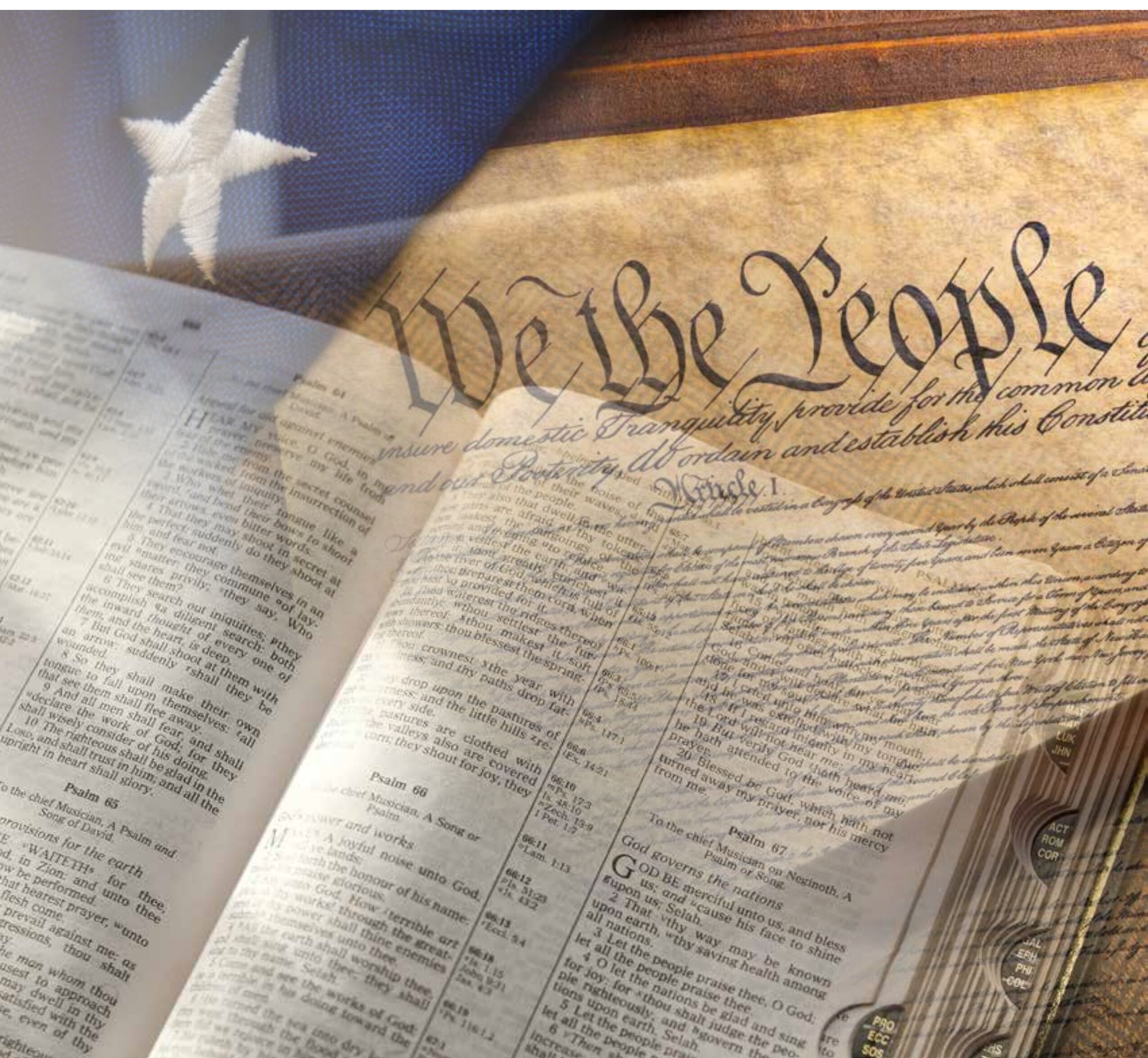
We live in an era where the drumbeats of patriotism are beating louder and louder. Prominent Christian leaders are demanding their constitutional rights. The lines between the church and the state are slowly being blurred. The world is deliberately chipping away at the two-kingdom principle that is clearly taught in the New Testament, practiced by the early church, and revived by our Anabaptist forefathers during the Reformation. Yet the descendants of these very same Anabaptists are slowly surrendering ground to this drumbeat of patriotism.
To reinforce in our minds the Biblical value of separation from church and state, we want to look at the Bill of Rights and compare it with the New Testament.
The United States Bill of Rights is the first 10 amendments to the United States Constitution, adopted as a single unit in 1791. It constitutes a collection of guarantees of individual rights and limitations on federal and state governments. These amendments have binding legal force and are considered fundamental to American democracy.
In 1791, the United States Bill of Rights meant nothing to Anabaptists living in America. They were quietly living out their faith in a land where they were not being persecuted or martyred for their faith. But times have changed. The world, and more specifically, the nominal Christian world, is knocking at our doors. They are loudly clambering that Christians demand their rights.
Does the Christian have rights?
From which kingdom do they obtain their rights? From the Bible or the Constitution? Let's take a look.
First Amendment
Establishment Clause, Free Exercise Clause; freedom of religion, speech, the press, and assembly; the right to petition. (In this article, the Bill of Rights is truncated to capture the principle.)
What does the Bible say?
The Christian does not have the right to freedom of speech. He cannot say whatever he wants.
“But let your communication be, Yea, yea; Nay, nay: for whatsoever is more than these cometh of evil” (Matthew 5:37).
A Christian is called to have virtuous speech.
“Sound speech, that cannot be condemned; that he that is of the contrary part may be ashamed, having no evil thing to say of you” (Titus 2:8).
Christians are called to preach.
“And he said unto them, Go ye into all the world, and preach the gospel to every creature” (Mark 16:15). “Let the dead bury their dead: but go thou and preach the kingdom of God” (Luke 9:60).
Christians may not have the right to exercise their religion the way they want or to lawfully assemble.
“But when they persecute you in this city, flee ye into another . . . (Matthew 10:23).
Second Amendment
The right to have a militia (United States), to a Sovereign state, and right to keep and bear arms.
What does the Bible say?
Christians may not bear arms to defend themselves.
“Jesus answered, My kingdom is not of this world: if my kingdom were of this world, then would my servants fight . . . (John 18:36).
We have weapons, but our weapons are not earthly.
“For the weapons of our warfare are not carnal, but mighty through God to the pulling down of strong holds” (2 Corinthians 10:4).
Fighting brings consequences.
". . . he that killeth with the sword must be killed with the sword . . .” (Revelation 13:10).
Third Amendment
The right of protection from quartering of troops.
What does the Bible say?
The Christian is not only obliged to be subservient to our enemies but goes beyond what is required.
"But I say unto you, That ye resist not evil: but whosoever shall smite thee on thy right cheek, turn to him the other also. And if any man will sue thee at the law, and take away thy coat, let him have thy cloak also. And whosoever shall compel thee to go a mile, go with him twain. Give to him that asketh thee, and from him that would borrow of thee turn not thou away. Ye have heard that it hath been said, Thou shalt love thy neighbour, and hate thine enemy. But I say unto you, Love your enemies, bless them that curse you, do good to them that hate you, and pray for them which despitefully use you, and persecute you;” (Matthew 5:39-44).
"Not rendering evil for evil, or railing for railing: but contrariwise blessing; knowing that ye are thereunto called, that ye should inherit a blessing” (1 Peter 3:9).
Fourth Amendment
The right of protection from unreasonable search and seizure.
What does the Bible say?
Is the servant greater than the Lord? If our Lord suffered cruel punishment, we should expect more.
". . . The servant is not greater than his lord. If they have persecuted me, they will also persecute you; if they have kept my saying, they will keep yours also” (John 15:20).
"And immediately, while he yet spake, cometh Judas, one of the twelve, and with him a great multitude with swords and staves, from the chief priests and the scribes and the elders. And he that betrayed him had given them a token, saying, Whomsoever I shall kiss, that same is he; take him, and lead him away safely. And as soon as he was come, he goeth straightway to him, and saith, Master, master; and kissed him. And they laid their hands on him, and took him" (Mark 14:43-46).
Fifth Amendment
The right to remain silent, due process, double jeopardy, self-incrimination, eminent domain.
What does the Bible say?
The Christian does not have the right to remain silent.
"But when they deliver you up, take no thought how or what ye shall speak: for it shall be given you in that same hour what ye shall speak . . . What I tell you in darkness, that speak ye in light: and what ye hear in the ear, that preach ye upon the housetops” (Matthew 10:19, 27).
The Christian does not have the right to that which God made him steward over.
"And if any man will sue thee at the law, and take away thy coat, let him have thy cloak also”(Matthew 5:40)
Everything belongs to God.
“. . . the LORD gave, and the LORD hath taken away; blessed be the name of the LORD” (Job 1:21).
"As every man hath received the gift, even so minister the same one to another, as good stewards of the manifold grace of God” (1 Peter 4:10).
Sixth Amendment
Trial by jury and rights of the accused; Confrontation Clause, speedy trial, public trial, right to counsel
Seventh Amendment
Civil trial by jury.
(In this study, we combined the Sixth Amendment with the Seventh Amendment since both are of a similar subject.)
What does the Bible say?
The Christian does not sue others at law. While the context here is a brother taking a brother to law, the same could apply to unbelievers.
"Dare any of you, having a matter against another, go to law before the unjust, and not before the saints” (1 Corinthians 6:1).
"For ye had compassion of me in my bonds, and took joyfully the spoiling of your goods, knowing in yourselves that ye have in heaven a better and an enduring substance” (Hebrews 10:34).
Eighth Amendment
Prohibition of excessive bail and cruel and unusual punishment.
What does the Bible say?
The Christian is promised cruel and unusual punishment.
"But beware of men: for they will deliver you up to the councils, and they will scourge you in their synagogues” (Matthew 10:17).
Ninth Amendment
Protection of rights not specifically enumerated in the Constitution.
See below for the Christian’s Bill of Rights
Tenth Amendment
Powers of States and People. The powers not delegated to the United States by the Constitution, nor prohibited by it to the States, are reserved to the States respectively, or to the people.
What does the Bible say?
The Christian’s power does not come from the state. Christians have received power through the Holy Ghost by Jesus Christ himself.
"But ye shall receive power, after that the Holy Ghost is come upon you: and ye shall be witnesses unto me both in Jerusalem, and in all Judaea, and in Samaria, and unto the uttermost part of the earth” (Acts 1:8).
Around the year 200, a Christian minister named Tertullian wrote, “Indeed, render to Caesar, money. Render to God, yourself. Otherwise, what will be God’s if all are Caesar’s?” Paraphrased in modern English, it would read: give your money to Caesar (the government) but give yourself to God. If you give both your money and yourself to Caesar, what is left for God?
What is the Christian’s Bill of Rights?
The right to take up the Cross
"And he said to them all, If any man will come after me, let him deny himself, and take up his cross daily, and follow me. For whosoever will save his life shall lose it: but whosoever will lose his life for my sake, the same shall save it" (Luke 9:23-24).
"Then Jesus beholding him loved him, and said unto him, one thing thou lackest: go thy way, sell whatsoever thou hast, and give to the poor, and thou shalt have treasure in heaven: and come, take up the cross, and follow me” (Mark 10:21).
The right to die to ourselves
"For if ye live after the flesh, ye shall die: but if ye through the Spirit do mortify the deeds of the body, ye shall live” (Romans 8:13).
"And they that are Christ's have crucified the flesh with the affections and lusts” (Galatians 5:24).
"Yea doubtless, and I count all things but loss for the excellency of the knowledge of Christ Jesus my Lord: for whom I have suffered the loss of all things, and do count them but dung, that I may win Christ” (Philippians 3:8).
The right to live otherworldly
"'Love not the world, neither the things that are in the world. If any man love the world, the love of the Father is not in him. For all that is in the world, the lust of the flesh, and the lust of the eyes, and the pride of life, is not of the Father, but is of the world. And the world passeth away, and the lust thereof: but he that doeth the will of God abideth for ever” (1 John 2:15-17).
The right to a Spirit-filled life
"And I will put my spirit within you, and cause you to walk in my statutes, and ye shall keep my judgments, and do them” (Ezekiel 36:27).
"If ye love me, keep my commandments. And I will pray the Father, and he shall give you another Comforter, that he may abide with you for ever; Even the Spirit of truth; whom the world cannot receive, because it seeth him not, neither knoweth him: but ye know him; for he dwelleth with you, and shall be in you. I will not leave you comfortless: I will come to you” (John 14:15-18).
The right to eternal life
"He that hath an ear, let him hear what the Spirit saith unto the churches; To him that overcometh will I give to eat of the tree of life, which is in the midst of the paradise of God” (Revelation 2:7).
"Blessed are they that do his commandments, that they may have right to the tree of life, and may enter in through the gates into the city” (Revelation 22:14).
Around the year 300, a pagan named Lucilius wrote, “It is virtue to give that which is really due to honor . . . That is, we should consider the interest of our country first, those of our parents should come next, and our own interests should be in the third and last place.”
In response to this, Lactantius, an early Christian church teacher, wrote, “It is a virtue to restrain anger, to control desire, and to curb lust. For this is to flee from vice . . . If desire is restrained, no one will use violence by land or by sea. Nor will anyone lead an army to carry off and lay waste the property of others . . . It is not virtue, either, to be ‘the enemy of the bad’ or ‘the defender of the good’. . . For what are the interests of our country, but the hardships of another state or nation? To extend the boundaries that are violently taken from others, to increase the power of the state, or to improve revenues. All of these things are not virtues, but the overthrowing of virtues.” -- Antinicene Fathers, 7.168, 169
To summarize, Lactantius is saying there is no virtue in patriotism.
To which kingdom do we belong?
If we belong to the kingdom of this world, we will abide by the revered document of this world, the US Constitution. We will fight for its principles with sword and gun and advocate for its candidates through activism and electioneering. We will align with its values in speech and by what we read. We belong to the world, and our final destination is already determined.
If we belong to the kingdom of Jesus Christ, we will abide by the values of the Bible. The weapons of our warfare are not carnal but mighty through God. We take up the cross of Jesus Christ, and him alone will we represent. Our speech and lifestyle will easily be distinguished as that of a Christian. We belong to the kingdom of Jesus Christ, and our final destination is already determined.