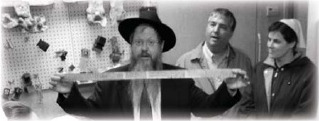
Looking down onto the floor of the Brooklyn Synagogue, our tour guide, Rabbi Beryl, explained the scene before us. He pointed out the men tightly and methodically wrapping their phylacteries around their arms, the married men donning their prayer shawls, and the rhythmic bobbing of austere, bearded men chanting liturgical prayers in conservative dress. Rabbi Beryl explained that these men were preparing for the Sabbath. Contrasting these acts of piety and devotion, other plain-dressed worshippers buzzed around, sharing sandwiches and casual conversation.
I was escorting a group of high school students on a tour of an Orthodox Jewish community located in Brooklyn, New York. Making the drive from the “horse-and-buggy” community of Lancaster County to the phylactery-wearing community of Brooklyn, New York, is full of many curious contrasts and comparisons. The obvious comparison was apparent. Walking around with my camera looking at men with dark clothes and long beards made me feel like a tourist in Lancaster County waiting for a shoofly pie and a buggy ride. On the surface, the tendency is to say that these Hasidic Jewish people walk around in dead, dry orthodoxy, following laws and regulations to earn their salvation. This same comparison is typically said of the Anabaptist/Old Order settings. However, I found some parts of their expression of being “in the world but not of the world” impressive.

What I found that was disturbing really surprised me. It was something a lot closer to my Evangelical background than I had thought. I found that instead of being “dry,” these people were actually very “spiritual.” I found that as far as “spirituality” goes in the general sense of the word, these people were closer to Charismatics than to Amish. They spoke of frequent personal revelations, and personal “spiritual” meanings to various parts of the Bible. The Rabbi even told me that some of the more “spiritual” men could tell the spiritual state of somebody just by hearing their name! They spoke of putting Scripture all over their houses. But more than just a reminder and an effort to get the Scriptures into their hearts, they felt that the Scriptures on the wall conveyed some kind of power. The Rabbi told me that if you have a problem in your home—ranging anywhere from marriage problems to finances—inevitably the problem could be traced back to something messed up in the actual print of the Scripture on the wall, such as two letters touching in the script. He said that once the scribe fixes the messed up text, your problems go away!
This challenged me to think of how I really use the Word of God. The Word of God is simple. But if we don’t follow the simple Word we tend to start making a lot of stuff up. We end up with strange “spiritual” meanings to simple Scriptural concepts. What’s worse, we can tend to “spiritualize” away important Scriptural concepts. The commands of Christ are often replaced with excuses and euphemisms. Concepts like “grace” and “faith” are morphed into spiritual nuances without real meanings. This must stop! The Bible is easy to understand—if we would just stop explaining it away! The Bible is not a spiritual “Juju” to be placed on the wall; it has real meaning for our everyday life. Furthermore, spiritual insights are great, but to trust them and miss the plain words of Jesus is really the worst bondage of all.
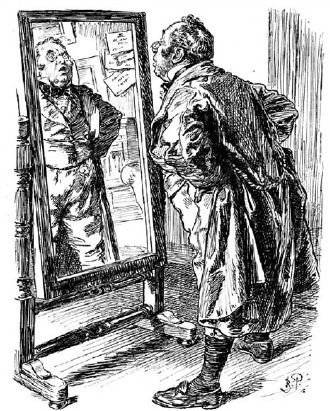
In this issue, Mike Atnip deals with some well-quoted verses that many people seem to use as an almost “Abracadabra” to give them an assurance of salvation. It seems if one can quote the words of Ephesians 2:8, they are counted as having entered the kingdom despite obvious disobedience to the plain teachings of Christ. In other articles, we take a look at calculating our potential in the kingdom, and then a filtering system that will simplify and purify the decisions we make in our day by day walk. We also take a look at the simple teachings of the Bible concerning our clothes. The teachings of the Bible are not really hard to grasp … but our human nature screams to find some way to get around them it seems. Oh, if we can but just have our room full of mirrors broken to see into the beauty of God’s holy nature!
Rounding up this issue is also a response to a portion of a letter we received. It comes down to an issue of gospel vs. gospel. Simply doing what Jesus taught us versus turning the Scriptures into a “Juju” or “Abracadabra” to hang on our walls or quote from to make us feel good. Lord help us all!
~Bro. Dean