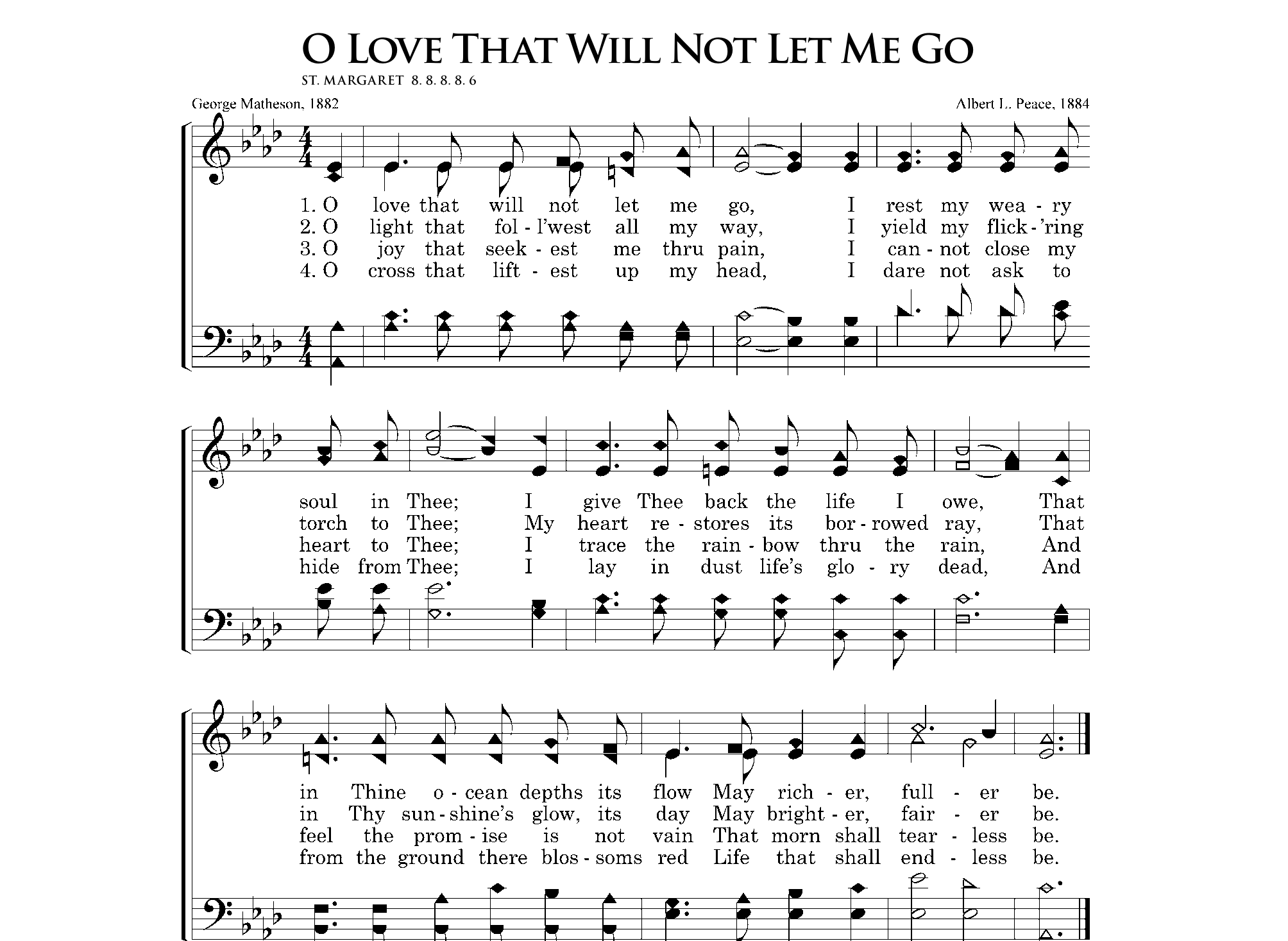
This hymn is generally thought to be one of the most loved hymns written during the latter part of the 19th century. The writing of this thoughtful and beautifully constructed text is even more amazing when we consider that its author was one who was almost completely blind and who describes the writing of this hymn as the “fruit of much mental suffering,” and “the quickest bit of work I ever did in my life.”
Born in Glasgow, Scotland, March 27, 1842, George Matheson had only partial vision as a boy, and, after entering Glasgow University, his eyesight continued to fail rapidly. Except for “moments of shadowy eyesight”, he was totally blind by the age of 18. This affliction of blindness seemed to be a tragedy since he was an eager and avid scholar, yet it caused him to trust in the Lord, and it strengthened his walk with God.
He entered the university at the early age of 15 and graduated with high honors in 1861 at the age of 19. He was a brilliant scholar, even spending four more years after graduation in more theological studies, all the while remaining single. After his graduation he became entirely dependent on others, relying much upon his two sisters, who were so dedicated that they learned Latin, Greek, and Hebrew since they thought it might aid him in his theological studies. One of them continued to be his faithful co-worker and helper throughout his life, assisting in his calling of being a pastor and other ministerial duties.
After completing his theological course, he became assistant pastor to the renowned Dr. Macduff, in whose church of thousands of members he had been brought up. Soon, however, he was chosen minister of the Church of Scotland in the seaport summer resort of Innellan. Here he stayed for eighteen years. Many families came to spend the summer there chiefly to be inspired by his preaching ministry.
Whenever he preached, the open Bible was before him as he stood in the pulpit, and to the congregation, he seemed to be reading from it. During the messages, his eyes looked straight at the congregation, and many went away with no clue that they just listened to a blind preacher. It was during this time that he made a practice of memorizing his sermons, as well as the passages of Scripture he used in his messages. His memory was so sharp that if someone read one of his prepared sermons to him twice, or whatever else he wanted to memorize, he could from then on repeat it perfectly. One Sunday, however, after doing this for 12 years, when in the middle of a powerful sermon his memory completely collapsed, and the topic on which he was preaching vanished from his mind. He sat down and commenced to request a psalm to be sung, and, after the song, with perfect calmness told the audience what had happened. With this done, he stood to his feet, gave out a new text, and preached an impromptu sermon of great power. After that experience George wrote little of his sermons, and finally prepared only an outline from which to preach.
Dr. Matheson’s final pastorate was taken up in 1886 at the age of 44 where he became pastor of the large St. Bernard’s Parish Church in Edinburgh, where his eloquent preaching consistently attracted large throngs of people to the services. Here he remained for 13 years, his church growing from 1,494 members to 1,703 in the first 5 years. He continued faithfully preaching the gospel and became well known as one of Scotland’s outstanding preachers and pastors and was greatly esteemed in Edinburgh where he resided.
Many speculations have been made regarding the cause of the mental distress which prompted the author to write this text. A very popular account, although never verified, is that this text was a result of the severe trial Matheson faced after his soon-to-be bride left him just before their marriage when she learned of his impending total blindness. Although this story cannot be documented, there are many significant hints in this hymn reflecting a saddened heart, such as the “flickering torch” and the “borrowed ray” in the second verse, the tracing of the “rainbow through the rain” in the third stanza, as well as the “cross” in the last verse.
Fortunately, Dr. Matheson did relate an account of his writing of this hymn:
“My hymn was composed in the manse of Innellan on the evening of June 6, 1882. I was at that time alone. It was the day of my sister’s wedding, and the rest of the family were staying overnight in Glasgow. Something happened to me, which was known only to myself, and which caused me the most severe mental suffering. The hymn was the fruit of that suffering and was the quickest bit of work I ever did in my life. A genuine inspiration, I had the impression rather of having it dictated to me by some inward voice than of working it out myself. I am quite sure that the whole work was completed in five minutes and equally sure it never received at my hands any retouching or correction. I have no natural gift of rhythm. All the other verses I have ever written are manufactured articles; this came like a dayspring from on high. I have never been able to gain once more the same fervor in verse.”
The hymn first appeared in the Church of Scotland monthly magazine, Life and Work, in January 1883. The tune was composed one year later by a prominent Scotch organist of his day, Albert L. Peace, who was asked to write a tune especially for Matheson’s text.
Peace’s own account of the writing of this fine tune is as follows, “After reading it over carefully, I wrote the music straight off, and may say that the ink of the first note was hardly dry when I had finished the tune.” The origin or the tune name, St. Margaret, is unknown except that it is a name much revered in Scotland, and certainly because of the beloved Queen Margaret of Scotland.
The later years of Matheson’s life from the age of 57 to his death at age 64 were spent in writing some of the finest devotional writings in the English tongue, including Moments on the Mount, Voice of the Spirit, and Rests by the River. Although this is his only hymn found in most hymnals, he did write a few other fine hymns, including “Make Me A Captive Lord”, and “Then I Shall Be Free.”
The four key words of “O Love, That Wilt Not Let Me Go” are: love, light, joy, and cross. These words have been described as the complete satisfaction for any believer whose life is totally surrendered to the will of God. It could take the rest of one’s life to completely discover the personal significance of these four expressions.
References:
101 Hymn Stories
Treasury of Hymn Stories
Author -George Matheson, 1842 – 1906
Composer -Albert L. Peace, 1844 – 1912