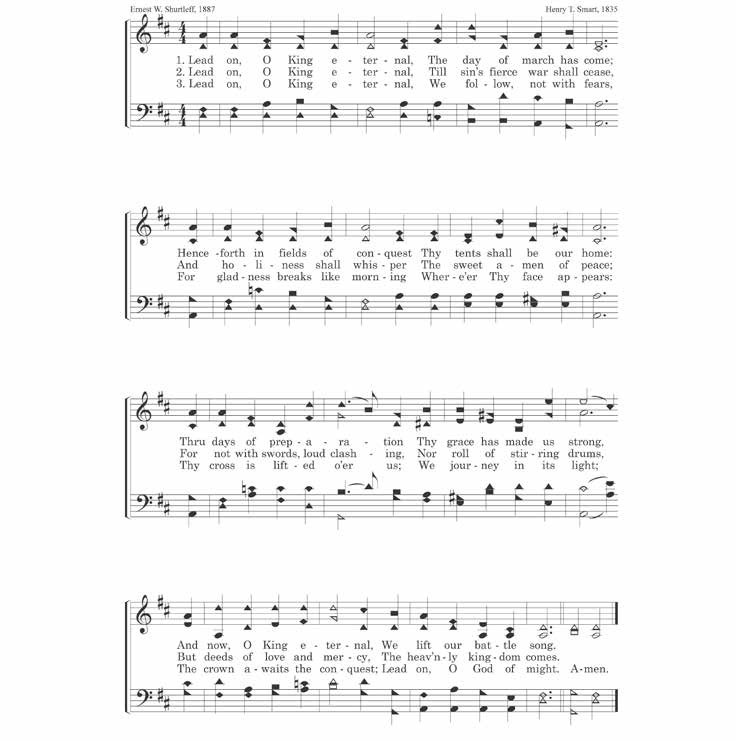
Once again we will be taking a look at the history behind one of our beloved hymns. These hymns of old have stood the test of time and are worth singing, and may they continue to be sung till time is no more! Out of the hundreds of songs that the old-time hymn writers have written, only a handful remain today. These "tried and true" pieces of history continue to bless our congregations on every Lord's day morning, as we lift our voices to sing the lines that our forefathers have sung for generations.
The hymn history for this issue, unlike some of the others we've looked at, is not born out of deep grief, catastrophic experiences, or dramatic conversions. Rather, it is the heartfelt cry of a godly young man as he finished his studies and was ready to enter his calling as a minister of the gospel. “Lead On, O King Eternal,” is the exclamation of my heart as well, seeing the current state of the world and our own country. May we never forget that this world's system is not eternal. It is passing away, and we as followers of Christ have been called out of this world to follow the King Eternal, whose kingdom will never end!
Ernest W. Shurtleff was born in Boston, Massachusetts, on April 4, 1862. In 1887, after he spent much time studying and preparing, he was ready to begin his ministry. His classmates at Andover Theological Seminary, recognizing the poetic ability of their colleague, asked him to write a hymn that they might all sing together for their commencement service. Shurtleff responded with this excellent text, and together, they sang this song for the first time. At the time of his graduation, he had already published two volumes of verses, and throughout his later ministry wrote a number of additional hymns.
Our hymn writer was truly the embodiment of the hymn he wrote. Before moving to Europe, he served as a minister in Congregational churches in Ventura, California; Old Plymouth, Massachusetts; and Minneapolis, Minnesota. In 1905, he established the American Church in Frankfurt, Germany, and in 1906, he moved to Paris, France, where he was involved in student ministry at the Academy Vitti.
When World War I broke out, Ernest and his wife remained in Paris to help with relief work. But he did not live to see the war end. He passed away there in 1917 at the young age of 55. Ernest published a number of literary works during the course of his life His most enduring work is, “Lead On, O King Eternal.”
The hymn was first published in the graduation program of Andover Theological Seminary and then appeared in Hymns of Faith in 1890. The future of the hymn text was assured when it was included in The Hymnal 1895, published by the Presbyterian Church in the U.S.A. The text was paired with a variety of tunes. In 1905 it was paired with the tune "Lancashire" by London composer Henry Smart and appeared for the first time in The Methodist Sunday School Hymnal 1911. By 1930, “Lead On, O King Eternal” appeared almost exclusively with the tune "Lancashire" in the United States.
One interesting note about this hymn is that the tune we know today was written 52 years before the song. “Lancashire,” the tune for “Lead On, O King Eternal,” was originally composed in 1835 for a festival celebrating the 300th anniversary of the English Reformation. It was published in a leaflet for the occasion and was set to the words “From Greenland’s Icy Mountains.” The tune was named after the county Lancashire, where its composer worked at the time of its origin. Seventy years later, the tune was paired with the words for “Lead On, O King Eternal” in The Methodist Hymnal.
Henry Smart was born in England in 1813. Though he studied some music with his father, he was largely self-taught. Originally, Henry chose to study for a law degree. However, he eventually changed course and decided to pursue a career in music. He developed a reputation as a gifted musician, and he served as the organist at a number of leading London churches.
Henry struggled with poor eyesight for a number of years before he became almost totally blind around 1865. This infirmity was hard for him. However, he continued playing by memory. He continued to make contributions to the field of music for the next 14 years till 1879, when he passed away at the age of 66. During the course of his life, Henry published and worked as the musical editor for several collections of music. He also composed a number of other works — the tunes for “Angels from the Realms of Glory” and “Lead On, O King Eternal” are among his most familiar to us today.
Let us conclude this with a wonderful and comforting verse from the last book of the Bible.
“And the seventh angel sounded; and there were great voices in heaven saying, The kingdoms of this world are become the kingdoms of our Lord, and of his Christ; and he shall reign for ever and ever.” Revelation 11:15
Sourced from 101 hymn stories, Hymnary.org