“O the depth of the riches both of the wisdom and knowledge of God! how unsearchable are His judgments, and his ways past finding out! For who hath known the mind of the Lord? Or who hath been his counsellor? Or who hath first given to him, and it shall be recompensed unto him again? For of Him, and through Him, and to him, are all things: to whom be glory for ever. Amen” (Rom. 11:33–36).
What an exuberant and expressive exclamation written by Apostle Paul! As we look at a new hymn and hymn writer again, let’s keep our minds alert and hearts open to see the hand of God at work.
Matthew Bridges was born at Malden, Essex, in England, on July 14, 1800. He began to publish verses in 1825 and continued until he had published two small volumes of hymns—Hymns of the Heart (1848) and The Passion of Jesus (1852). From here, I will continue with the story by giving a brief history of the church life of our hymnodist.
The hymn writer we are studying in this article was a part of the Anglican Church of England. Around the middle of the 19th century, he became dissatisfied with the church group he was with and found himself following the leading of John Henry Newman in what was called the Oxford Movement. According to hymnologist Albert Bailey, this movement centered on, “Claiming for their Anglican Church lineal descent from the original Apostolic Church.” In pursuit of this, the organization’s followers studied the ancient history of the church, its doctrine, and especially its liturgy. In doing so, they discovered a wealth of Greek and Latin hymnody from the earliest centuries of the Christian church.
As sadly, we find many factions in the Christian church today, so also was the scope of things going on in the mid–1800s. The Oxford Movement seemed in some ways to be a competition between the old and the new way of doing things. In the case of the figure in our story today, it seems he saw a more stable path forward in keeping the old traditions of the mother church, yet he also seemed to have a real, living faith in our Lord and Savior Jesus Christ. Now, I want to interject here that I trust his decision was made in all good conscience toward God, even though we look on today from an Anabaptist viewpoint and question his reasons for doing so.
We will continue with our story here. Matthew Bridges converted to Roman Catholicism and, wanting to share in the rich hymnic tradition of the Protestant Church, began writing original hymns. Mr. Bridges’ hymns are marked by spirituality and genuine power. One of his hymns we love and enjoy is “Rise, Glorious Conqueror.” Undoubtedly, his greatest hymn is “Crown Him with Many Crowns.” It first appeared in his book The Passion of Jesus, and was originally given the title “The Song of the Seraphs.”
There is an interesting background connected to this hymn, including how there came to be 12 verses. Understandably, only a portion of those verses are being sung today. The selection of verses depends on the hymnal.
Matthew Bridges originally penned the song in 1851. He wrote six stanzas, all based upon Rev. 19:12: “ ... and on His head were many crowns.” The edition by Bridges continued until the 1870s when a devout Anglican clergyman named Godfrey Thring came along. Godfrey was concerned that this popular hymn allowed catholic theology to be sung by protestant congregations. His concerns centered perhaps on Bridges’ original second verse, where he referenced the Blessed Virgin Mary. In light of this, Thring wrote six new stanzas and published it in his Hymns and Sacred Lyrics in 1874.
The 12 stanzas have been mixed and matched down through the years. Interestingly, of the six verses most commonly appearing in hymnals today, three were written by Bridges and three by Thring. The hymn, as published in the Hymns of the Church songbook, completely omits original verse 2 and uses verses 1, 3, 4, part of 5, and part of 6 out of Bridges’ original six verses. The stanzas we sing in that book are highlighted in the selection of verses below. Also included as well are the six couplets by Thring.
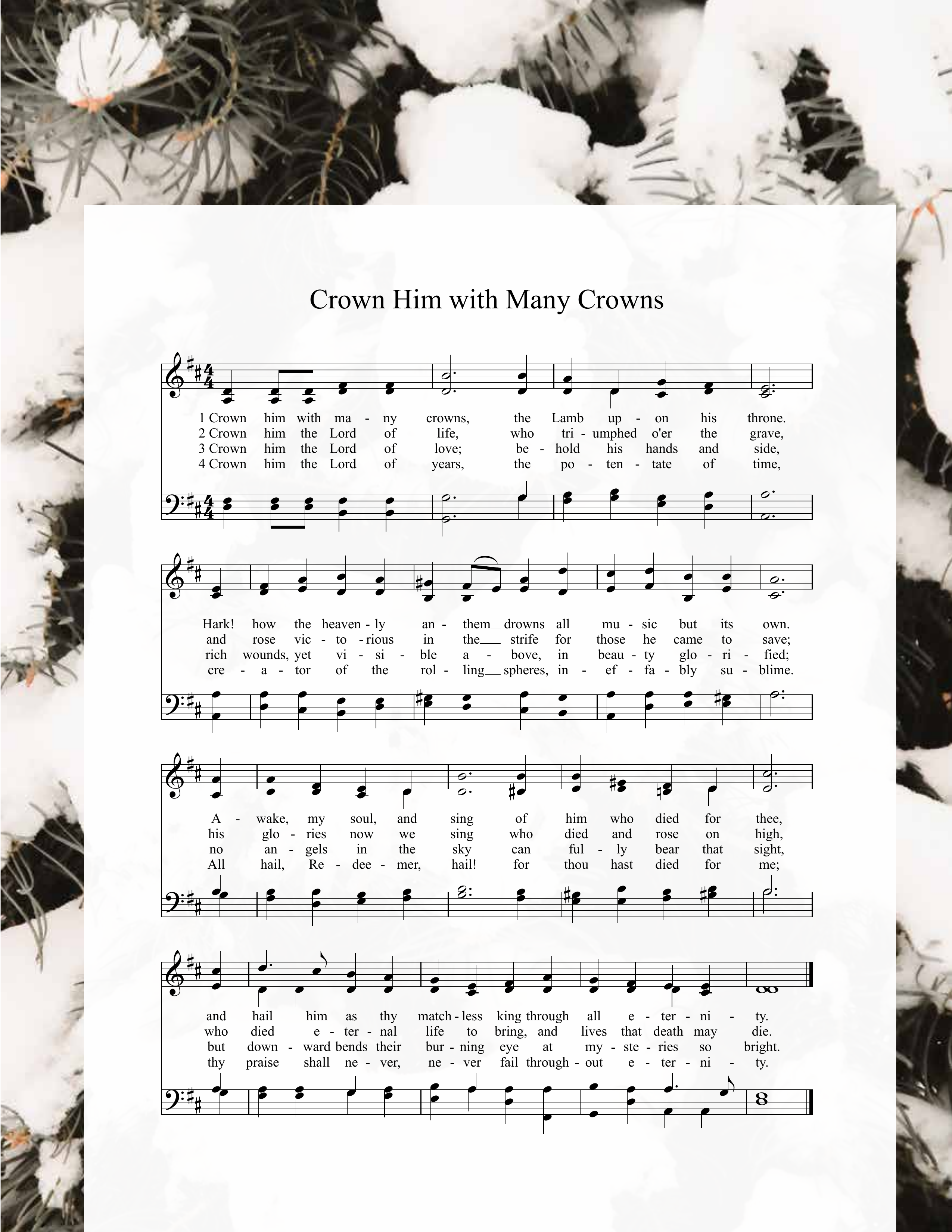
Crown Him with Many Crowns
—Bridges
Crown Him with many crowns, the Lamb upon His throne;
Hark! how the heavenly anthems drowns all music but its own;
Awake, my soul, and sing of Him who died for thee,
And hail Him as thy matchless King through all eternity.
Crown Him the Virgin’s Son! The God Incarnate born—
Whose arm those crimson trophies won which now His brow adorn!
Fruit of the mystic Rose as of that Rose the Stem:
The Root, whence mercy ever flows—the Babe of Bethlehem!
Crown Him the Lord of peace! Whose power a scepter sways,
From pole to pole, that wars may cease, absorbed in prayer and praise:
His reign shall know no end, and round His pierced feet
Fair flowers of paradise extend their fragrance ever sweet.
Crown Him the Lord of love! Behold His hands and side—
Rich wounds, yet visible above, in beauty glorified:
No angel in the sky can fully bear that sight,
But downward bends his burning eye at mysteries so bright!
Crown Him the Lord of years! The Potentate of time—
Creator of the rolling spheres, ineffably sublime!
Glassed in a sea of light, where everlasting waves
Reflect His throne—the Infinite! Who lives—and loves—and saves.
Crown Him the Lord of heaven! One with the Father known,
And the blest Spirit, through Him given from yonder triune throne!
All hail! Redeemer—Hail! For Thou hast died for me;
Thy praise shall never, never fail throughout eternity!
Crown Him with Many Crowns
—Thring
Crown Him with crowns of gold, all nations great and small,
Crown Him, ye martyred saints of old, the Lamb once slain for all;
The Lamb once slain for them who bring their praises now,
As jewels for the diadem that girds His sacred brow.
Crown Him the Son of God before the worlds began,
And ye, who tread where He hath trod, crown Him the Son of man;
Who every grief hath known that wrings the human breast,
And takes and bears them for His own, that all in Him may rest.
Crown Him the Lord of light, Who o’er a darkened world
In robes of glory infinite His fiery flag unfurled.
And bore it raised on high, in heaven—in earth—beneath,
To all the sign of victory o’er Satan, sin, and death.
Crown Him the Lord of life Who triumphed o’er the grave,
And rose victorious in the strife for those He came to save;
His glories now we sing Who died, and rose on high.
Who died, eternal life to bring and lives that death may die.
Crown Him of lords the Lord, Who over all doth reign
Who once on earth, the incarnate Word, for ransomed sinners slain,
Now lives in realms of light, where saints with angels sing
Their songs before Him day and night, their God, Redeemer, King.
Crown Him the Lord of heaven, enthroned in worlds above;
Crown Him the King, to whom is given the wondrous name of Love,
Crown Him with many crowns, as thrones before Him fall.
Crown Him, ye kings, with many crowns, for He is King of all.
Matthew Bridges lived his latter years in the province of Quebec, Canada, then returned to England before his passing from earth on October 6, 1894, at the ripe old age of 94. Although we don’t find many details about his life, he has left one of the greatest hymns in our hands today.
A great part of this song’s enduring quality is the tune it is paired with. This refrain was written especially for this song by Sir George Job Elvey in 1868 and was given the name of Diademata. In Greek, the word diademata means “a royal crown”—a fitting name for this stirring melody. Hymnology scholar J. R. Watson agrees with this when he observes, “Diademata makes a magnificent setting for the text, march-like and joyful without ever becoming mechanical or strident.”
May our congregations continue our practice of corporate, whole-hearted singing, lifting our voices in praise to the Lord in the assembly of the saints! Crown Him, our Lord Jesus Christ, with many crowns, for he is worthy!
Sourced from: A Treasury of Hymn Stories, hymnary.org, umc-discipleship.org, FBC