Let us draw near with a true heart in full assurance of faith, having our hearts sprinkled from an evil conscience, and our bodies washed with pure water –Hebrews 10:22
Imagine with me what it would be like to be blind. You would live life in the shadows, or perhaps even in complete darkness. You might be able to tell the difference between light and dark, but you couldn't see any objects. There would be little difference between your day and night, except for the change in the shadows that surround you. You could hope and wish and even try your hardest to see things and still only see nothing but a blur. To your physical eyes, what a sad and stark reality—no eyesight—no ability to see anything, no hope of seeing like a normal person. But to your spirit:
…Blessed assurance, Jesus is mine!
…Oh, what a fore-taste of glory divine!
…Visions of rapture now burst on my sight!
…Watching and waiting, looking above!
…Praising my Savior all the day long.
This was the life story of one of the world’s best poets and hymn writers. She had a full and blest life of nearly four score and fifteen years in service for the Lord. It is estimated that she wrote more than 8,000 gospel song texts in her lifetime. The hymn "Blessed Assurance" is considered by many to be among the top 10 hymns ever written. “The hymns she wrote have been and are still being sung more frequently than those of any other gospel hymn writer," as quoted from 101 Hymn Stories. Her contribution to modern hymnity has been a great and important part of sacred worship for the past one and a half centuries.
Fanny Jane Crosby, born on March 24, 1820, in southeast Putnam County, New York City, was the only child of her parents, John and Mercy Crosby. Her father tragically passed away when she was only six months of age, leaving her mother alone to support the family working as a maid. Fanny was primarily raised by her Christian maternal grandmother, who played a significant role in her upbringing and education. Her beloved grandmother devoted much of her time to reading the Bible and sharing selected poetry and literature with her. As a result of this, the young Fanny developed an impressive ability to memorize lengthy passages from both the Old and New Testaments by actively listening to her grandmother.
She also began writing at a young age and penned her first poem at the age of eight:
Oh, what a happy child I am,
Although I cannot see!
I am resolved that in this world
contented I will be.
How many blessings I enjoy
That other people don't!
So weep or sigh because I'm blind,
I cannot, nor I won't.
Her blindness began when she developed inflammation in her eyes at two months of age. Their family physician was unavailable at the time, so a stranger, who claimed to be a medical professional, treated her. This quack doctor applied poultices to her eyes in an attempt to eliminate the infection. Although the infection was successfully cleared, the poultices left behind white scars that caused damage to her vision. They sought the help of a renowned surgeon in New York, but he was unable to restore her sight. As a result, Fanny could only perceive the presence of absence of light and could no longer see physical objects.
It is amazing that anyone, and especially a blind person, could write on such a vast variety of experiences and spiritual truths with such skill, speed, and proliferation. There is no doubt in my mind that the blessing of God was on her life, as she responded in such a positive way to the devastating physical handicap she lived with every day. There is also surely no question in anyone's mind that Fannie had a tremendous gift of verse, that very likely was strengthened by her inability to see.
For a considerable season of her life, while working with a music publisher, she wrote three new hymns each week. She used over 200 pen names besides her own as a humble way to conceal her identity. Although she has been gone for over a century, some of her original hymn texts have continued to be uncovered up to the recent past.
At the age of 38, in the year 1858, Miss Crosby married Alexander Van Alstyne, a music composer, who, like her, had vision problems. Despite being married, Fanny continued to use her maiden name as her signature when publishing her hymns.
Fanny Crosby's hymns came about in a variety of ways. Often, the theme for a song was inspired by a suggestion from a visiting minister desiring a new song on a certain subject. At other times, musician friends would compose the music first, then ask her for the words. This was the case for the hymn, "Blessed Assurance."
One day, in 1873, when Fanny was 53 years of age, Mrs. Joseph Knapp, a close friend of hers, and one who loved composing music as a pastime, played this melody for her and asked, "What does this tune say?" Fanny responded immediately, "Why, that says 'Blessed assurance, Jesus is mine.'" She proceeded to add words to that phrase, until she had the words of this classic hymn completed.
Fanny Crosby died in 1915, just 40 days before her 95th birthday, leaving behind a wealth of spiritual encouragement, exhortation, and consolation that has touched hearts and continues to change lives. Engraved on Fanny J. Crosby's tombstone at Bridgeport, Connecticut, are these significant words taken from our Lord's remarks to Mary, the sister of Lazarus, after she had anointed Him with costly perfume: "She hath done what she could." Only eternity will reveal the multitudes of people who have been won to a saving faith in Jesus Christ by one of her hymns.
Other hymns by Fanny J. Crosby include "All the Way My Savior Leads Me", "Jesus Keep Me Near the Cross", "My Savior First of All", "Rescue the Perishing", and "To God be the Glory."
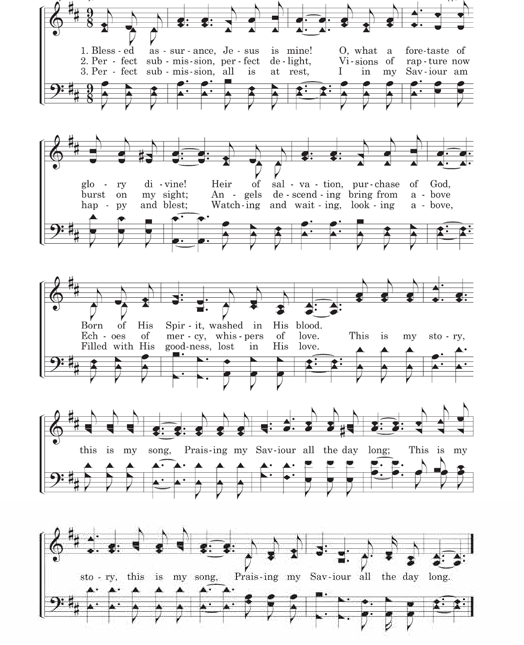
Words:
Fanny J. Crosby, 1873
Lyrics:
Phoebe P. Knapp, 1873