Thou art worthy, O Lord, to receive glory and honour and power: for thou hast created all things, and for thy pleasure they are and were created –Revelation 4:11.
This hymn, often called the “National Anthem of Christendom,” is perhaps one of the greatest of hymns of all time. It was written by Edward Perronet, first appearing in the November 1779 issue of Gospel Magazine. It was edited by Augustus Toplady, who is also the author of another well-known hymn, “Rock of Ages”. The text of this hymn, All Hail the Power of Jesus Name, has been translated into almost every language where Christianity is known. Wherever it is sung, it communicates to the spiritual needs of human hearts. One writer has said, “So long as there are Christians on earth, it will continue to be sung; and after that, in heaven.”
Edward Perronet was born at Sundridge, Kent, England, in 1726. He was a descendant of a distinguished French Huguenot family who had fled to Switzerland and later to England because of the religious persecution in France. Edward’s father, a pastor in the State Church of England, was strongly sympathetic with the evangelical movement spearheaded by the Wesleys and George Whitefield. Edward, too, like his father, became a minister in the Anglican Church but was always critical of its ways. Once he wrote, “I was born and I am likely to die in the tottering communion of the Church of England, but I despise her nonsense.” Soon, however, he broke from the Church and threw himself strenuously into the evangelistic endeavors of the Wesleys during the 1740s and 1750s.
Charles Wesley writes of Edward Perronet’s boldness in preaching. At one time he and Perronet were beset in a house by a mob of rough revilers, whom Perronet opposed courageously, while they abused him and threw dirt on him. It was during this time that the Wesleys and their followers suffered much persecution and even violence from those who disagreed with their ministry. Concerning these experiences, Wesley made the following notation in his diary: “From Rockdale we went to Bolton, and soon found that the Rockdale lions were lambs in comparison with those of Bolton.” Edward Perronet was thrown down and rolled in mud and mire. Stones were hurled and windows broken.
Another interesting account is given regarding the relationship between the Wesleys and Perronet. John Wesley wanted to hear Perronet preach, and he, being 18 years younger than John had always refused to preach in the older churchman’s presence. So, one day Wesley seeing Edward in the congregation announced that he would preach at the next service. Desiring to avoid a public conflict with Wesley, Perronet mounted the pulpit the next morning, but quickly explained that he had never consented to preach. “However,” he added, “I shall deliver the greatest sermon that has ever been preached on earth.” He then read the Sermon on the Mount and sat down without comment.
After eight years of co-operation with the Wesleys, Perronet’s strong-mindedness and free spirit caused a division between them, as he disagreed with some of their regulations. They continued, however, to esteem and love each other.
The last years of Perronet were spent at Canterbury, where he was pastor of an independent church, and where he died in 1792, at the age of sixty-six. His last words have also become a classic: “Glory to God in the height of His divinity! Glory to God in the depth of His humanity! Glory to God in His all-sufficiency! Into His hands I commend my spirit.”
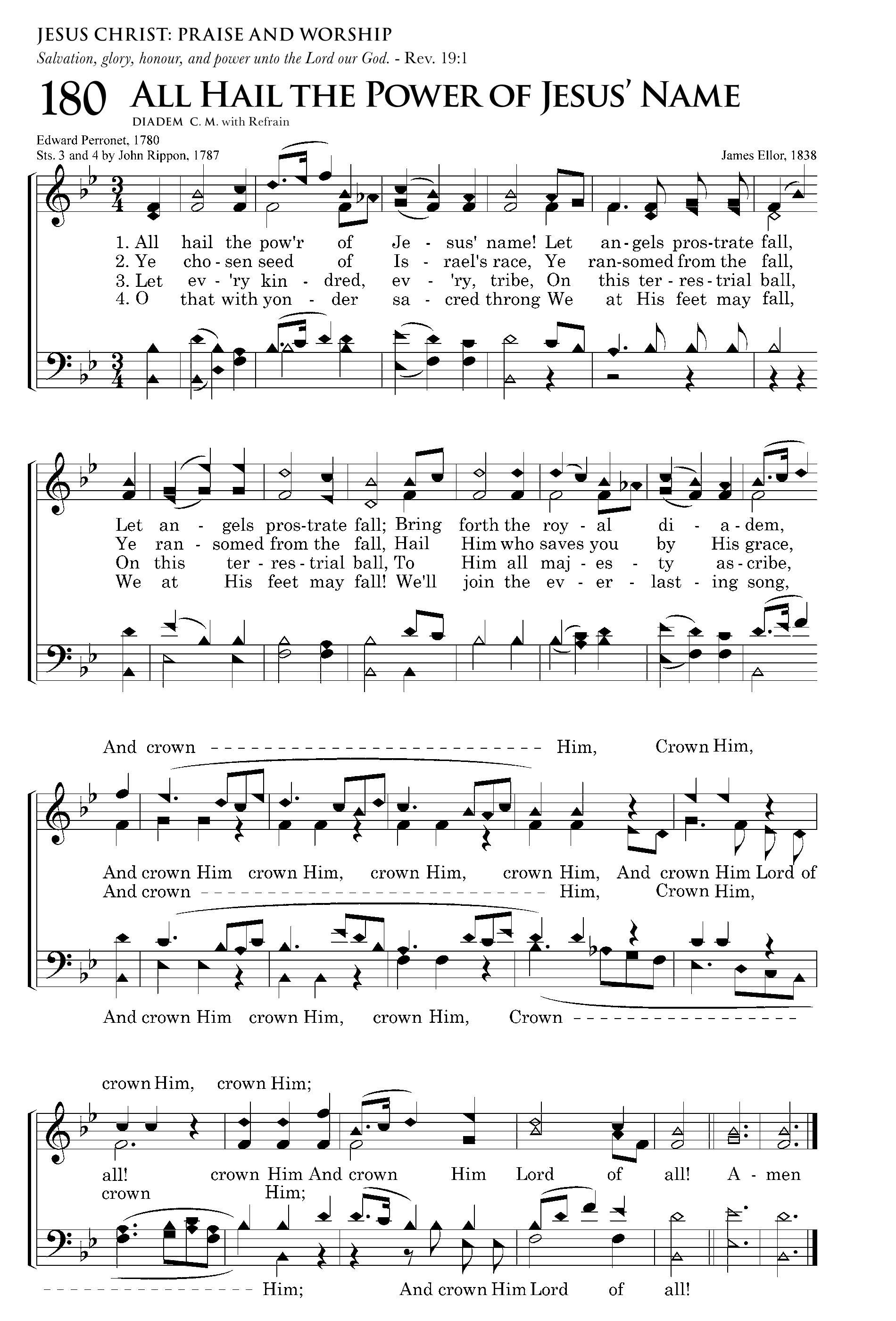
Though Perronet wrote many other hymns and forms of poetry, none of them, have attained fame except the immortal “All Hail the Power of Jesus Name.” The success of this text has, no doubt, been furthered by three fine tunes. “Coronation,” composed by Oliver Holden, a Massachusetts carpenter, self-taught musician, and respected singing-school teacher, is most widely used in America. “Miles Lane” composed by William Shrubsole, Perronet’s personal friend, is the most popular in Great Britain. While the festive “Diadem” tune, composed in 1838 for this text by James Ellor, an English layman, is frequently used as a choir number. This hymn was originally written having the title, “On the Resurrection,” and there were eight stanzas, as follows:
All hail the power of Jesus’ name,
Let angels prostrate fall
Bring forth the royal diadem,
To crown Him Lord of all!
Let high born seraphs tune the lyre,
And, as they tune it, fall
Before His face who tunes their choir,
And crown Him Lord of all!
Crown Him, ye morning stars of light,
Who fixed this floating ball,
Now hail the Strength of Israel’s might,
And crown Him Lord of all!
Crown Him, ye martyrs of your God,
Who from His altar call;
Extol the stem of Jesse’s rod,
And crown Him Lord of all!
Ye seed of Israel’s chosen race,
Ye ransomed of the fall,
Hail Him who saves you by His grace
And crown Him Lord of all!
Hail Him, ye heirs of David’s line,
Whom David Lord did call.
The God incarnate, Man divine,
And crown Him Lord of all!
Sinners, whose love can ne’er forget
The wormwood and the gall,
Go spread your trophies at His feet,
And crown Him Lord of all!
Let every tribe and every tongue
That bound creation’s call
Now shout in universal song,
The crowned Lord of all!
As it now stands in our hymnbooks, the hymn is shortened and changed, and one stanza has been added by the famous hymn collector, Rev. John Rippon, in 1787.
Oh, that with yonder sacred throng
We at His feet may fall;
We’ll join the everlasting song,
And crown Him Lord of all.
As we wrap up this amazing story of the life of Edward Perronet and the others who have had their part in bringing this immortal hymn to us, let’s take a look in closing at the effect this hymn has had on heathens who knew nothing about Jesus. The most famous story connected with Perronet’s great hymn is told of the missionary to India, Rev. E.P. Scott. One day he saw on the street a man of so strange an appearance that he inquired about him and learned that he belonged to a wild mountain tribe among whom Christ had never been preached. Mr. Scott prayed over the matter and decided to visit that tribe. As soon as he reached their mountain home, he fell in among a savage band of murderous tribesmen who were on a war expedition, and who were closing in on him with their spears. They seized him and pointed their spears at his heart. At once the missionary drew out the violin that he always carried with him and began to play and sing in the native language, “All hail the power of Jesus’ name!” He closed his eyes, expecting death at any minute. When he reached the fourth stanza, and nothing had happened, he opened his eyes, and was amazed to see that the spears had fallen from the hands of the savages, and big tears were in their eyes! They invited Mr. Scott to their homes, and he spent the remaining years of his life preaching and ministering God’s love and redemption to these people. God in His providence used a simple hymn as a means of introducing the gospel to a group of needy pagans.
References:
A Treasury of Hymn Stories
101 Hymn stories
“Coronation” Tune -Oliver Holden 1765-1844
“Miles Lane” Tune -William Shrubsole, 1760-1806
“Diadem” Tune -James Elliot, 1838
“Let Us Crown Him” Tune -James McGranahan 1840-1907